
Step out of the bright, bustling Piazza del Duomo in Milan and into another world. Suddenly, you’re walking on intricate mosaic floors under a soaring glass-and-steel sky. This is the Galleria Vittorio Emanuele II.
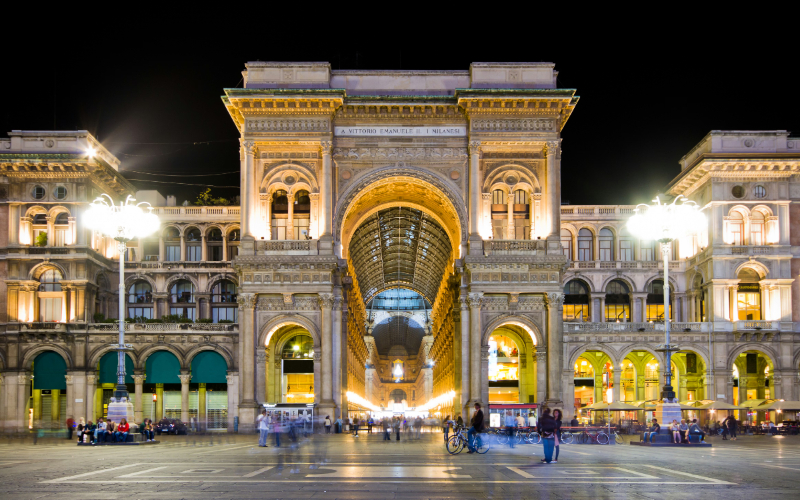
The Galleria Vittorio Emanuele II is Milan’s Iconic Shopping Marvel
Think of it as the great-great-grandfather of the modern shopping mall, but dressed in a tuxedo. The Galleria is a stunning public monument that is 150 years old.
It also has some of the world’s most luxurious brands. It is a public thoroughfare, open 24/7 for everyone to enjoy, and completely free to enter.
This grand, covered street was cleverly designed to link two of the city’s key places: the Duomo and the Piazza della Scala. Locals have long called it il salotto di Milano—Milan’s drawing room. It is a timeless and elegant place for city life. This spot shows that the world’s most beautiful shopping mall isn’t really a mall.
Why Was Italy’s Oldest Shopping Mall Really Built?
More than just a place to shop, the Galleria Vittorio Emanuele II was a bold statement. In the 1860s, Italy had just become a united country. The proud city of Milan wanted to build something amazing to celebrate this new time of unity and progress. Construction began in 1865, creating a monument that was as much about patriotism as it was about commerce.
The grand name itself is a massive clue to its purpose. The Galleria is named after Vittorio Emanuele II. He was the first king of the United Kingdom of Italy. Milan dedicated this new building to him. This was a strong way to honor the new nation. It also helped Milan show its status as a modern, leading city.

Its location wasn’t an accident, either. The visionary architect, Giuseppe Mengoni, designed the Galleria as a grand covered walkway. It links two important places in Milan.
The first is the Piazza del Duomo, which has a beautiful cathedral. The second is Piazza della Scala, home to the famous opera house. It physically and symbolically linked Milan’s religious heart with its cultural one.
The goal was to create more than a building. It was to make Milan’s living room—il salotto di Milano. Mengoni envisioned an elegant, light-filled space where people could stroll, meet for coffee, and see and be seen, regardless of the weather. This blend of national pride and brilliant urban design defines the history of Italy’s oldest shopping mall.
How a Revolutionary Glass Roof Came with a Tragic Secret
Look up in the Galleria, and you’ll see what made Giuseppe Mengoni’s architecture so revolutionary. The massive, arched ceiling isn’t made of stone but of cast-iron and glass—an incredible feat of engineering for the 1870s. This “glass vault” was advanced for its time. It was made to fill the grand shopping arcade with natural light. This created a bright, open atmosphere that was unlike anything seen before. It was a bold vision of Italy’s industrial future soaring over a public space.
This brilliant mix of old and new defines the Galleria’s design. The roof looked modern, but Mengoni designed the building’s facades with detailed statues and classic features.
This honored Italy’s rich artistic history. It was as if he had placed the sleek, modern canopy of a grand train station on top of a Renaissance palace. The entire structure was a powerful symbol, celebrating where the new nation came from and where it was headed.

Tragically, the man behind this vision never saw its official debut. On December 30, 1877, just one day before the king was to open the Galleria, Giuseppe Mengoni fell.
He fell from the scaffolding of his own central arch and died. While his legacy is cemented in that breathtaking glass roof, other stories are hidden in plain sight on the ground. You just have to know where to look, starting with the intricate floor mosaics.
What Do the Mosaics on the Milan Galleria’s Floor Actually Mean?
Glancing down from the breathtaking glass roof, you’ll notice the story of Italy continues right under your feet. The floor of the Galleria’s central octagon isn’t just decorative; it’s a patriotic map. The four large mosaics here represent key cities that served as capitals of the Kingdom of Italy. You’ll see Milan’s own coat of arms—a red cross on a white background—taking its place alongside three other historic powerhouses.
Identifying the others is like a quick lesson in Italian symbolism.
Look for the she-wolf nursing the twins Romulus and Remus, the unmistakable emblem of Rome. Nearby, a delicate lily on a red field represents Florence, the cradle of the Renaissance. The fourth mosaic, however, is the one that gets all the attention: a prancing bull, the city’s coat of arms.
You’ll almost certainly spot a small crowd gathered around that bull.
Local legend says that if you place your right heel on a certain part of the bull and spin around three times, you will get good luck. Over the years, the popular spinning of the bull of Turin tradition has worn down a noticeable spot in the tiles. It’s one of Milan’s most beloved rituals, and you can’t miss it.

Now you understand the secrets of the architecture and floor. You can now enjoy the famous Milan glass roof shopping arcade as it was intended. The stories don’t stop here—they continue inside the historic shops and cafes that line its grand corridors.
From Prada’s First Store to a Historic Aperitivo: What to Do Inside
Today, the corridors are filled with luxury brands like Louis Vuitton and Versace. However, one shop in the Milan gallery has a unique history. This is the home of Prada’s original store in Milan, first opened by Mario Prada in 1913. Still in its original location, it’s a living piece of fashion history. Look for the elegant mahogany shelves and the old sign above the entrance that reads “Fratelli Prada” (Prada Brothers).
Beyond the window shopping, the Galleria is where Milan comes to socialize.
For a local experience, try an aperitivo. This is a classic Italian drink served before dinner with small snacks. The legendary spot for this ritual is Camparino in Galleria, a historic bar at the arcade’s entrance. Ordering a ruby-red Campari here is a rite of passage, connecting you to a century-old city tradition. It’s one of the best restaurants inside Milan’s central arcade for atmosphere alone.
A Few Must-Do Experiences:
- Window shop the stunning displays of world-famous fashion houses.
- Enjoy a classic Milanese aperitivo at a historic cafe like Camparino.
- People-watch from a velvet chair as the city’s life flows by.
Whether you are looking at a store, enjoying a classic drink, or just watching people, you are part of a 150-year-old Milanese tradition. Knowing what to see and do inside is key, but timing your visit is the secret to a seamless trip.
When to Go and How to Get There: A Stress-Free Visiting Guide
Timing your visit is the secret to experiencing the Galleria at its most magical. To avoid crowds in the Milan gallery, visit early in the morning.
This is when the city is just waking up. The floors will be quiet, and golden light will stream through the glass roof, making for incredible photos. Alternatively, visiting the Milan shopping arcade at night offers a completely different, romantic atmosphere. When the shops have closed, and the crowds have thinned, the entire arcade glows under its own lights, feeling like a vast, private ballroom.
The Galleria is a public walkway that connects two important city landmarks. It is always open and free to enter. You can stroll through at midnight or sunrise, just as you would any other city street. Thankfully, getting there is just as simple.
The Galleria’s grand entrance is impossible to miss. If you are standing in the main square, Piazza del Duomo, and facing the magnificent Milan Cathedral, just look to your left. That enormous, ornate archway is your destination. Learning how to get from the Milan Cathedral to the arcade is as easy as turning your head.
From Tourist to Insider: Seeing the Milan Galleria With New Eyes
Many people see a nice roof over fancy stores. However, the Galleria Vittorio Emanuele II is much more than that. It is a living museum filled with secrets.
It’s a place where the architect’s tragic mark is seen in the design. The story of a nation is told through the floor mosaics. It’s il salotto di Milano—Milan’s Drawing Room—a central stage for the city’s daily life, not just a place to shop.
The next time you stand in this magnificent Milan central arcade, you can put that knowledge into action. Pause beneath the great glass dome. Look up at the architecture, down at the legendary bull, and all around at the city breathing around you. You will no longer be just passing through; you will be reading the story of Milan.


