Let’s get one thing straight: in Bologna, there’s no such thing as “spaghetti bolognese.”
If you want to enjoy one of Italy’s famous dishes, ask for tagliatelle al ragù. It is silky, fresh egg pasta with a rich, slow-cooked meat sauce. This is the first of many secrets Bologna offers and a perfect introduction to its traditional cuisine.
Bologna Travel Guide: Discover Top 10 Sights & Secrets
While many travelers flock to see Italy’s superstar cities, a growing number are discovering a more authentic alternative. For tourists deciding between Bologna and Florence, Bologna offers a vibrant, lived-in feel without the overwhelming crowds.
It’s a city for walking and getting lost under beautiful covered walkways. You can discover a part of Italy that feels both old and very alive.
So, what is Bologna famous for beyond its food?
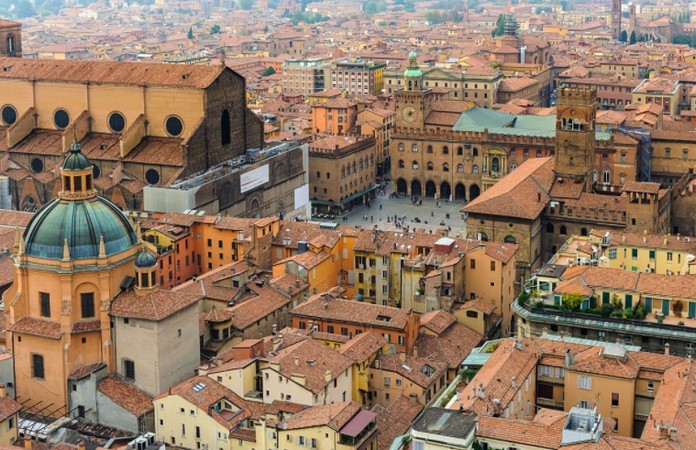
The locals will tell you it has three souls, captured in its nicknames. It’s called La Dotta (“the Learned”) because it has the oldest university in the Western world. It’s also known as La Grassa (“the Fat”) for its amazing food scene. Finally, it’s called La Rossa (“the Red”) for the warm, terracotta color of its rooftops and historic buildings.
This guide shares the ten essential sights and local secrets that bring La Dotta, La Grassa, and La Rossa to life. Get ready to explore Italy’s best-kept secret.
1. Start Here: Why Piazza Maggiore is Bologna’s Grand Living Room
Every great city has a heart, and in Bologna, it’s the sprawling Piazza Maggiore.
Think of this beautiful square as more than a landmark.
It is the city’s big outdoor living room. Here, locals meet, students relax, and many paths come together. It’s the perfect spot to get your bearings and the obvious starting point for any self-guided walking tour of Bologna.

Your eyes will immediately be drawn to the powerful Fountain of Neptune, a Renaissance masterpiece of bronze and marble. Just beyond it is the large and interesting front of the Basilica di San Petronio. This church is so big that it has its own story to tell.
Here’s a simple trick for avoiding crowds in Bologna: visit the piazza early in the morning. Before the busy day starts, you can see the city wake up. Grab a cappuccino from a nearby café. Enjoy the golden light on the old buildings. It’s a peaceful, magical moment that makes you feel less like a tourist and more like a true Bolognese.
2. Uncover the Secret Inside Bologna’s Giant, Unfinished Church
The huge Basilica di San Petronio stands over the piazza. You might wonder,
“Why does it look half-finished?” The simple answer: it is! The original plan was so ambitious that it would have rivaled St. Peter’s Basilica in Rome. This strong statement upset the Pope. As a result, funds were redirected. This left the top half in plain brick. It became a lasting symbol of Bologna’s independent spirit.
Inside, however, a different secret is hiding in plain sight. On the floor, look for a thin brass line cutting across the marble walkway. This is the Cassini Meridian Line, a giant astronomical instrument from 1655. Every day at noon, a beam of sunlight comes through a hole in the ceiling. It lands on this line, acting as the longest and most accurate sundial. This sundial is precise enough to help astronomers measure the length of the year.

Best of all, experiencing this piece of Bologna history is completely free. You can enter one of the largest churches in the world.
You can see its unique façade and admire a 17th-century solar observatory. Best of all, you can do this without spending any money. After enjoying the peaceful history, you can explore something new. Visit the lively food market in the city.
3. How to Eat Your Way Through the Quadrilatero Market Like a Pro
Just a short walk from the main square, you will enter the lively Quadrilatero.
This is Bologna’s old food market, full of delicious food. This maze of cobblestone alleys has been the city’s food center for centuries. It is the best place to understand Bologna’s nickname, La Grassa (The Fat). The sights and smells can be overwhelming, but navigating it like a pro is easy once you know what to look for.
Your mission is to find a classic salumeria, which is an old-school Italian deli. There, you can try the holy trinity of local flavors. Don’t leave without trying:
- Prosciutto di Parma: The world-famous, silky smooth cured ham.
- Parmigiano-Reggiano: The real deal—salty, nutty, and aged for at least 24 months.
- Mortadella: The original “bologna,” a delicate pork sausage with pistachios that is nothing like the American version.
The best way to try everything is to order a tagliere (pronounced tahl-YEH-reh).
It is a wooden board filled with local meats and cheeses. It often comes with bread. It’s the easiest and most authentic lunch you can have, perfect for sharing with a glass of local wine. Once you visit the best of the Quadrilatero market in Bologna, you will feel energized. Then, you can explore the city’s amazing viewpoint.
4. Should You Climb the Asinelli Tower? A Step-by-Step Guide to the Top
Looming over the city center are Bologna’s most famous landmarks: the Two Towers. The shorter, dramatically leaning one is the Garisenda, while the taller one is the Asinelli Tower. These structures were medieval skyscrapers, built by wealthy families to showcase their power. Today, they stand as iconic symbols of the city, and one offers an unforgettable adventure. This climb is a must-do for anyone planning a 3-day trip to Bologna.
The journey to the top is a definite workout—498 steps up a series of internal wooden staircases. But here’s the single most important tip: you must book your Asinelli Tower tickets online well in advance.
Entry is timed, and slots sell out days or even weeks in advance. Showing up and hoping to buy a ticket on the spot will almost certainly lead to disappointment.
So, is the climb worth the effort? Absolutely. The reward is a stunning 360-degree view of Bologna’s sea of terracotta roofs. This view gives the city its nickname, La Rossa (The Red). From this high view, you can see the city’s old streets. You can also appreciate the many covered walkways that make Bologna special.
5. Bologna’s Porticoes: Your Secret Weapon Against Sun and Rain
From the top of the Asinelli Tower, you saw them snaking through the city: a vast web of covered walkways. These are Bologna’s famous porticoes, and they are far more than just a pretty architectural feature. They began in the Middle Ages, when the boom in universities created a housing crisis. To create more space, building owners added upper floors over the public sidewalks. This made the sheltered paths you see today.
This amazing network is about 40 kilometers (25 miles) long. It is so special that it has been named a UNESCO World Heritage site. Exploring the unique features of Bologna’s porticoes is one of the best free things to do in Bologna. You can see ancient wooden ones and grand, painted archways. It makes the city a great spot for a self-guided walking tour. You stay dry in the rain and cool in the summer sun.
This clever medieval solution acts like a city-wide umbrella, connecting piazzas, shops, and cafes. You can cross almost the entire city center without ever leaving their cover.
These historic walkways will take you straight to the reason they exist: the world’s oldest university.
6. Go Inside the World’s Oldest University (and Its Shocking Theatre)
The university that sparked the city’s growth also gave Bologna its proudest nickname: La Dotta (The Learned One). To feel the weight of that nearly 1,000-year history, step inside the magnificent Archiginnasio, the university’s original 16th-century headquarters.
The walls of the courtyard and grand hallways are covered with many coats of arms painted in many colors. These were left by students and professors. They create a colorful display of academic life that goes back centuries.
But the real showstopper is hidden upstairs. The Anatomical Theatre, built in 1637, is a breathtaking amphitheater carved entirely from spruce wood.
This is where pioneering medical students came together to watch human dissections on the central marble slab. This practice was both new and shocking for its time. Look up at the detailed statues of famous ancient doctors like Hippocrates and Galen. They watch over the room from their carved spaces.
Visiting the theatre is a powerful, slightly chilling glimpse into the birth of modern science. After seeing this big moment in European history, it’s time to look for a smaller secret. You can only find it by peeking through a tiny, hidden window.
7. Find the ‘Secret Window’ to Bologna’s Hidden Canals
That intimate secret is hiding in plain sight on a street called Via Piella.
While it’s hard to imagine today, Bologna was once a major port city with a network of canals that transported goods. Most were paved over long ago, but a few remnants of this water-world are still visible if you know exactly where to look. This is where you’ll find the famous finestrella, or “little window.”
On a plain brick wall, you’ll spot a small, hinged wooden hatch. Go ahead and open it. Suddenly, a hidden world appears. It offers a colorful, charming view of the Canale delle Moline. This canal flows between the old houses.
It’s a surprising and very charming scene. It is often called Bologna’s “Little Venice.” This spot offers one of the most unique photo opportunities in the city.
This small peephole into a forgotten past is a free and quick experience.
It feels like a local secret just for you. Now that you’ve discovered one of the city’s hidden sights, it’s time to uncover one of its best-kept culinary secrets.

8. Go Beyond Ragù: The Other Bolognese Dish You Absolutely Must Try
While tagliatelle al ragù is Bologna’s most famous culinary export, the city’s heart truly belongs to another, more delicate dish. To experience traditional Bolognese cuisine like a local, you must try tortellini in brodo.
Forget thick sauces; this is about perfection in simplicity. Imagine tiny, jewel-like pasta rings, stuffed with a savory filling, floating in a rich, clear, steaming broth. It’s the best Italian comfort food. It’s a warm hug in a bowl that shows a different side of the city.
Each tortellino is a work of art, traditionally filled with a blend of pork, prosciutto, and Parmigiano-Reggiano. In Bologna, making them is a special holiday tradition. Tasting them feels like joining in a celebration.
You will find the best dishes in a classic trattoria. This is a cozy, family-run restaurant. Here, recipes have been passed down for many generations. Served in broth, the pasta’s pure flavor shines, a true testament to the quality of its ingredients.
Ordering this dish is like being let in on a delicious secret that many visitors miss.
After enjoying a taste of this comforting food history, you’ll be ready to explore a place built on layers of time.
9. How to Explore Seven Churches in One at the Santo Stefano Complex
Nothing in Bologna captures the city’s layered history quite like the Santo Stefano Complex. Locally called Sette Chiese (Seven Churches), this is not one building.
It is a fascinating collection of chapels, courtyards, and crypts built over a thousand years. It’s like a historical Russian doll, where stepping through one doorway transports you into an entirely different century. You might enter a Romanesque church only to find yourself in a peaceful medieval cloister moments later.
The real magic of Santo Stefano is the overwhelming sense of peace you feel inside. It’s a peaceful escape from the busy streets of the city. It is one of the most atmospheric historical sights in Bologna. Wandering through the ancient, worn stone corridors gives you a tangible connection to the past, no tour guide required. It’s the perfect place to slow down and simply absorb the immense history surrounding you.
Visiting this complex is a unique experience that offers a concise overview of Bologna’s long history. The next step is to fit this and other key spots into your visit. This is important if you are deciding what to do in Bologna for 3 days.
10. Your Perfect 3-Day Bologna Itinerary: Putting It All Together
After discovering its secrets, from the main square to its hidden canals, the last step is to experience it all. Three days is the perfect time to explore the city’s character. This plan will help you save time.
Here is what to do in Bologna for 3 days:
- Day 1: The Heart of the City. Get your bearings by climbing the Asinelli Tower, then descend into Piazza Maggiore. Explore the Basilica di San Petronio, then lose yourself in the Quadrilatero market for a classic lunch.
- Day 2: Culture & Secrets. Explore the academic heart of Bologna at the Archiginnasio. Then, look for the hidden canal at the Finestrella di Via Piella. Spend the afternoon exploring the layered history of the Santo Stefano Complex.
- Day 3: Views & Vittles. Dedicate your morning to a food tour or a pasta-making class. In the afternoon, walk up the world’s longest portico to the Sanctuary of San Luca for a great final view.
This itinerary helps you connect with the city’s true character. It shows its smart side, fun spirit, and warm, inviting welcome. You have the guide; now go find your Bologna.