Planning your trip from Rome to Florence by Train? The biggest mistake most travelers make isn’t choosing the wrong train company—it’s not realizing they should check two. Traveling from city center to city center is very easy on the high-speed train.
However, choosing between operators can be confusing. This guide makes it simple, ensuring you book the best ticket for your Italian adventure.
Rome to Florence by Train:
The Best Travel Tips & Ticket Deals
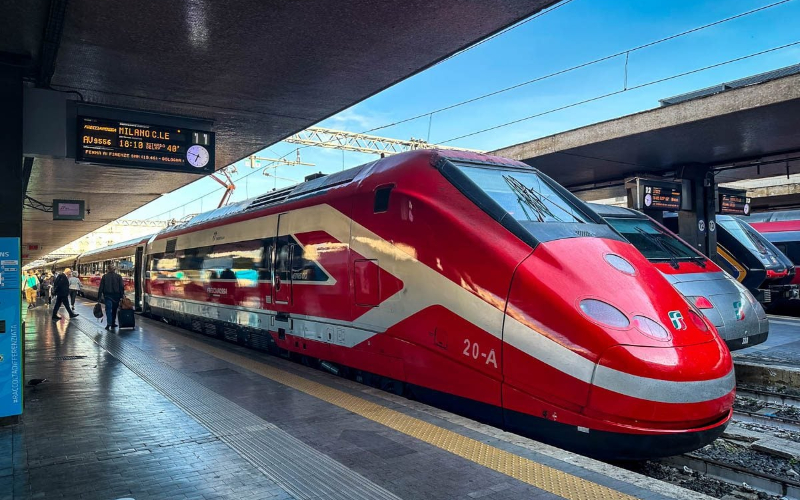
Think of the main train companies in Italy like you would competing airlines. For the popular high-speed train route from Rome to Florence, you have two great choices: Trenitalia and Italo. Trenitalia is the state-owned railway with its famous Frecciarossa trains. Italo is a modern private competitor.
Both services are fast, comfortable, and will get you to your destination in about 90 minutes. For travelers, this competition is a fantastic advantage.
When you think about Trenitalia and Italo, the “best” company is the one with the best price or schedule for your trip. In practice, their fares are dynamic.
For a 10:00 AM departure, Trenitalia may cost €49 and Italo €55. However, for a 10:30 AM train, Italo might be €45. To be sure, follow this simple strategy: always check both the Trenitalia and Italo websites before you book.
How to Get the Best Price: Why Booking Early Is Crucial
If you want the cheapest way to travel from Rome to Florence, book your high-speed train tickets early. Unlike local city buses, the prices for the fast trains operated by Trenitalia and Italo are dynamic. This means they work like airline tickets.
The closer you get to your travel date, the more popular the time, and the more expensive the seats become. The price you see today for a trip next month will almost certainly be higher if you check again next week.

For popular routes like Rome to Florence, the best time to book train tickets online is usually 3 to 4 weeks before your trip. This is when you can often find fares that are 50% cheaper—or even less—than what you’d pay on the day of travel. Planning ahead is the key to saving money. This lets you spend more on gelato and museum tickets.
Waiting until the last minute can be surprisingly expensive. To give you a clear idea of how train ticket prices change, here’s what you can expect for a standard one-way ticket:
- Booking 1-3 months ahead: €25 – €50
- Booking 2-4 weeks ahead: €50 – €80
- Booking in the last week: €80 – €150+
A little bit of planning makes a huge difference.
A Step-by-Step Guide to Booking Your Ticket Online
Booking your ticket early to secure a good price is straightforward.
You can use the official Trenitalia or Italo websites, or a trusted app. The steps are almost the same. You can finish them in minutes on your phone or computer.
The single most important step is selecting the correct stations. To travel from Rome’s main station to Florence’s main station, you need to enter the official Italian names. For your departure, type in Roma Termini. For your arrival, enter Firenze Santa Maria Novella. You will often see this shortened to Firenze S.M.N. on schedules. Choosing these specific stations ensures you arrive right in the heart of the city, ready to explore.

Once you’ve selected your stations and travel date, you’ll see a list of available trains. Check the departure times and prices from Trenitalia and Italo.
This will help you find the best option for your schedule and budget. After you choose your train, you will need to enter your name and email. Then, you can go to a secure payment screen that accepts major credit cards.
After your purchase is complete, you will immediately receive an email containing your e-ticket. This ticket will have a confirmation number and, most importantly, a QR code. T
his is your actual ticket. There is no need to print it out or validate it at the station. Simply save the email or a screenshot of the QR code on your phone.
When the conductor comes by on the train, you will just show them the code on your screen. That’s it—you’re all set for your journey.
Which Station?
Getting from Rome Termini to Florence S.M. Novella
When you search for tickets, you might see several station options for both Rome and Florence. For the quickest and easiest trip, choose Roma Termini as your departure station. Select Firenze Santa Maria Novella (often called Firenze S.M.N.) as your arrival station. These are the main stations in each city. They are the main stops for all high-speed trains. These trains travel from Rome to Florence in just 90 minutes.
This choice is crucial for convenience. Arriving at Florence’s Santa Maria Novella station puts you right in the heart of the action. From the platform, you are just a 10-minute walk from the magnificent Duomo and steps away from the city’s historic core. Rome’s Termini station is a key transportation hub. Metro lines go directly to the Colosseum, the Spanish Steps, and Vatican City. This makes it easy for you to arrive and depart.
By sticking to these main stations, you can avoid a common mistake. This mistake is booking a ticket to a suburban station, such as Firenze Rifredi or Roma Tiburtina. These stations have trains, but they are outside the city center. This means you must find and pay for another train, bus, or taxi to reach your hotel or the main attractions. Choosing Termini and S.M.N. from the start ensures your trip is as simple and efficient as possible.
First Class vs. Second Class: Is the Upgrade Worth It?
As you book your ticket, you’ll be asked to choose a service level. The names are different. Trenitalia’s high-speed Frecciarossa trains offer Standard and Business classes. Its competitor, Italo, uses Smart and Prima. The choice is really between a standard second-class ticket and a premium first-class ticket. An upgrade won’t get you to Florence any faster. All passengers on a specific train arrive at the exact same time, regardless of class.
The difference comes down to comfort and amenities. While both classes offer a modern and pleasant experience, the upgrade provides a noticeable increase in personal space. Here’s a breakdown of what to expect on Frecciarossa and Italo trains:
- Second Class (Standard/Smart): A good basic experience with comfy seats, power outlets, free Wi-Fi, and plenty of luggage space.
- First Class (Business/Prima): This class includes all the features of the second class. It also offers wider leather seats, more legroom, a free welcome drink and snack, and a quieter cabin.
For a trip this short, is the upgrade worth it? For most travelers, the answer is no. Second class is perfectly comfortable and provides everything you need to enjoy the journey. You can save your money for an extra museum ticket or a fantastic meal in Florence. If you see a good deal with a small price difference, such as €10- €15, consider upgrading to first class. It can offer more space. First class can be a nice, affordable luxury.
Your Travel Day Guide: Navigating the Station and Train
On the day of your trip, getting around a big station like Rome Termini may feel scary. However, it is easier than an airport. For high-speed trains, you don’t need to worry about long security lines or a formal check-in process. Simply plan to arrive at the station about 20 minutes before your train’s scheduled departure time. This gives you plenty of relaxed time to orient yourself, grab a coffee, and find your way without feeling rushed.
Once inside, your first task is to find one of the large electronic departure boards. Look for the big screen labeled Partenze, which is Italian for “Departures.” Scan the board to find your train by matching the train number and destination (Firenze S.M. Novella) from your ticket. The main piece of information you need is the platform number. You can find it in the Binario column, which is shortened to Bin. Don’t panic if it isn’t there right away; platform numbers are often posted only 10 to 15 minutes before the train leaves.
After your platform is announced, you can head to the train and board.
A common question is what to do with your bags. The process for luggage on high-speed Italian trains is easy: just carry it with you. Onboard, there are large luggage racks at the end of each car for your big suitcases. You will also find overhead space above your seat for smaller bags, just like on an airplane. This easy process is what to expect on Frecciarossa trains and Italo trains alike.
Find the car (carrozza) and seat (posti) numbers on your ticket, stow your bags, and settle in for the quick, scenic 90-minute journey. This entire process is designed for speed and convenience, making the high-speed train the easiest choice for most travelers.
What About the Slower Regional Train?
While looking for the cheapest way to travel from Rome to Florence by Train, you’ll likely see tickets for the Regionale train. These are indeed less expensive, but it’s a classic case of getting what you pay for. Instead of the swift 90-min ride you get on a high-speed train, the regional journey takes 3.5 to 4 hours. That’s a significant chunk of your precious vacation day spent on a slower, less direct route with multiple stops.
The experience on a regional train from Rome to Florence is also very different. Think of it less like a comfortable express service and more like a local commuter line. These trains often lack assigned seating, have less space for luggage, and offer fewer amenities. Most travelers think saving a little money isn’t worth the extra two hours of travel time. They also feel that the trip is less comfortable.
Most importantly, these tickets come with a critical rule you must know to understand Italian train ticket types. If you buy a paper ticket for a Regionale train (which doesn’t have a specific time or seat), you must validate it before boarding. This means stamping your ticket in one of the small green or yellow machines on the platform. If you forget this simple step, you could face a big fine. This frustrating situation is easy to avoid. Just stick with the faster high-speed option.
Your 5-Step Checklist for a Perfect Train Journey
Booking your train ticket from Rome to Florence is simple once you know the key steps
. By planning ahead and picking the right stations, you can avoid common mistakes. This will help you save money and enjoy a smooth Italian adventure. To make it even easier, here is your final checklist for a smooth journey.
Your 5-Step Checklist:
- Check prices on both Trenitalia.com and Italotreno.it.
- Book 3-4 weeks in advance for the best price.
- Select ‘Roma Termini’ to ‘Firenze Santa Maria Novella’.
- Arrive at the station 20 minutes early and find your platform (Binario).
- Sit back, relax, and enjoy the 90-minute scenic ride through Tuscany.
This high-speed route is a highlight of any travel guide to Italy.
In just 90 minutes, you will travel from ancient Rome to the birthplace of the Renaissance. You can do this without the stress of airports or traffic.
Whether you’re taking a day trip from Rome to Florence by train or moving on to your next destination, you are now completely prepared. Buon viaggio!