Imagine gliding through the Tuscan countryside. Watch cypress trees blur past your window. There are no traffic jams, no confusing road signs, and no parking problems.
This is the magic of traveling in Italy by train. So, is traveling in Italy by train a good idea? Yes, it’s not just a good idea; for most visitors, it’s the best one.
Traveling Italy by Train: The Ultimate Guide
Renting a car might seem romantic, but it often leads to unexpected headaches.
Many first-time visitors are caught off guard by Italy’s Zone a Traffico Limitato (ZTL), or limited traffic zones. Driving into a restricted area in a historic city center can result in a hefty fine. You may receive this fine months after your trip.
In contrast, train travel bypasses all of that stress. High-speed trains take you directly from one city to another. For example, the Rome-to-Florence route saves you hours. You won’t waste time on airport transfers or finding your way on unknown roads.
The Two Key Players: Trenitalia vs. Italo Explained for Tourists
When you book train tickets in Italy, you’ll immediately notice two main companies: Trenitalia and Italo. Think of it like choosing between two different airlines. Trenitalia is the state-owned national railway. It provides service all over the country, from big cities to small towns. Italo is a new private company. It focuses on high-speed trains in Italy. These trains connect major cities like Rome, Florence, Venice, and Milan.
The most important difference is their network. If your trip takes you to a smaller town in Tuscany or Sicily, you will use Trenitalia. However, if you are traveling the popular tourist route between major cities, you have a choice. Here’s a simple breakdown:
- Trenitalia: The classic national carrier. It covers the entire country with every type of train, from super-fast to slow and local.
- Italo: The modern competitor. It runs only sleek, high-speed trains between major cities, often with a modern, airline-like feel.
 For popular routes like Rome to Florence or Milan to Venice, always check both. Their prices can vary significantly depending on the day and time.
Both have great websites and apps that are easy to use in English. A quick search on both can save you a surprising amount of money.
Fast vs. Slow: Choosing the Right Type of Italian Train
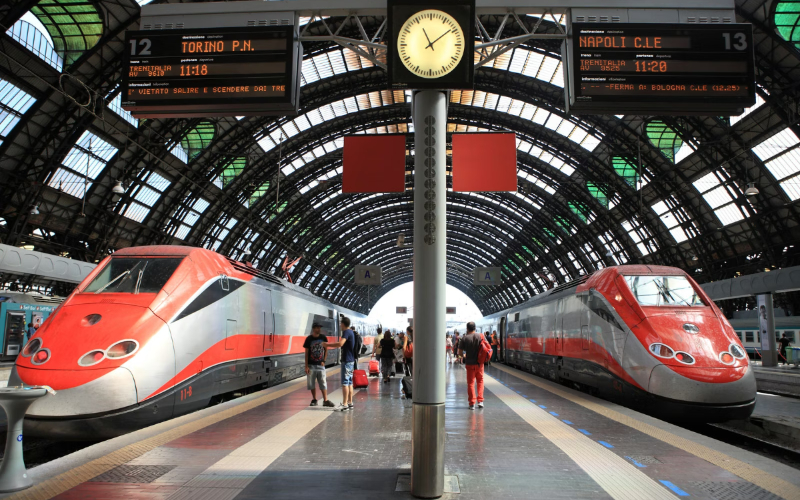
For traveling between major cities like Rome, Florence, and Venice, high-speed trains are your best friends. These sleek, modern trains travel up to 186 mph (300 km/h). All of Italo’s trains fit into this group. This also includes Trenitalia’s top services, especially the Frecciarossa (Red Arrow). Although they cost more, they can change a 4-hour drive into a 90-minute relaxing trip. They take you straight from one city center to another.
On the other end of the spectrum are Trenitalia’s slower, more local trains. InterCity trains offer a comfortable option. They connect major cities and towns, but they make more stops and go slower. The most basic and cheapest service is the Regionale train. These are the local workhorses of the Italian rail system, stopping at nearly every small town. They are perfect and budget-friendly for short trips, like a day trip from Florence to Pisa or Bologna.
As a rule of thumb, if your journey is more than two hours by car, a high-speed train is worth every penny. For shorter distances or exploring the countryside, a Regionale train will save you money and get you there reliably.
How to Book Tickets Online and Save Money
The best way to manage your budget is to book high-speed tickets online and in advance. Just like with airlines, the closer you get to your travel date, the more expensive tickets become. For popular routes like Rome to Florence, book your Frecciarossa or Italo seat three to four weeks in advance. Use their official websites to get a “Super Economy” fare. This can save you 50-70% compared to buying a ticket on the day of travel.
When booking, be sure to use the specific Italian station names, because major cities have multiple stations. Vuoi quasi sempre la stazione principale:
Roma Termini per Roma, Firenze Santa Maria Novella per Firenze, Venezia Santa Lucia per Venezia e Milano Centrale per Milano. This ensures you arrive in the heart of the city, not a suburban outpost.
This advance-booking strategy only applies to fast trains. For a short trip on a slower Regionale train, like from Florence to Pisa, buying tickets weeks in advance does not help. The price is fixed. You can confidently buy these tickets from a machine at the station on the day of your trip without worrying about a price hike.
READ THIS: How to Avoid a €50 Fine with One Simple Action
A physical ticket for a regional (Regionale) train has one very important catch. Unlike a high-speed ticket for a specific train and time, this one is flexible. To prevent it from being used repeatedly, you must validate it before you board. In Italian, this is called convalidare. Forgetting this simple step can result in a significant on-the-spot fine, so it’s the most important rule for local train travel.
Look for the small, freestanding validation machines. They are usually green and white or yellow. You can find them in the main station hall and at the entrance to every platform (binario). Simply slide the end of your paper ticket into the slot. You’ll hear a whirring sound as the machine prints the current date and time, activating your ticket.
This rule does not apply to all tickets. If you booked a high-speed train (like a Frecciarossa or Italo) with an assigned seat, your ticket is already valid.
The same goes for any digital ticket with a QR code on your phone. This validation step is exclusively for paper tickets without a seat reservation.
How to Read the Train Station Departure Board Like a Local
Stepping into a major Italian train station like Roma Termini can feel chaotic, but finding your train is simple. Locate a large digital display screen and look for the word Partenze (Departures) at the top.

The most reliable way to find your train is to match your train number. Your ticket has a specific number (e.g., “FR 9518”), which is the detail to find on the board. This is important because your train from Rome to Florence might actually go to Milan. So, the final destination on the board could say “Milano Centrale” instead of Florence. Matching the number ensures you’ve found the right service.
Once you’ve located your train, look for the column labeled Binario (platform). It is normal for platform numbers to be posted just 15 minutes before departure. So, don’t worry if this column is blank. Find a spot with a clear view of the board and wait for it to appear. As soon as your Binario number is displayed, you can confidently head to your platform.
First Class vs. Second Class: Is the Upgrade Really Worth It?
On Italy’s high-speed trains, there’s no bad choice. Second class, known as Standard on Trenitalia and Smart on Italo, is comfortable and clean. It has enough space for almost all trips. You’ll have a reserved seat, power outlets, and room for your luggage.
So, what do you get for upgrading? First class is more comfortable. It is also surprisingly affordable if you book early. On Trenitalia, it’s called Business.
On Italo, it’s called Prima. Think wider, plusher seats with more legroom and a quieter atmosphere. You’ll often be greeted with a complimentary welcome drink (even a prosecco!) and a small snack, all brought to your seat.
The decision comes down to trip length. For a short hop like the 90-minute ride from Florence to Rome, second class is more than sufficient. For a longer journey of three hours or more, like from Venice to Naples, the upgrade adds comfort. It makes the trip feel like part of the vacation.
The Italy Rail Pass: A Trap for Most Tourists?
A single pass for all your train travel sounds simple, but in Italy, this is one “deal” most travelers should avoid. You’ll almost certainly save more money without it.
The pass often fails because of deeply discounted advance-purchase fares. To plan a typical tourist route, start with Rome to Florence, then Florence to Venice.
Booking high-speed tickets directly with the operator can save you money. If you book a few weeks in advance, you can find prices as low as €20-€30 per leg of your trip. The daily cost of a rail pass is often more than double that.
The real catch is that the pass is not an all-inclusive ticket.
For every high-speed train, you must make a separate seat reservation. This reservation has a fee of about €13 per person for each trip. This hidden cost adds up fast, wiping out any potential savings and adding an extra booking step.
An Italian rail pass is best for a specific type of traveler.
It suits those who need last-minute flexibility for long trips. Most tourists can plan their city-to-city travel a few weeks in advance. For these travelers, buying individual tickets is a better choice. It is smarter, cheaper, and easier.
Your Final Checklist for a Stress-Free Journey
On the day of your train journey, a few final details can make all the difference for a relaxing trip.
- Luggage is easy. Forget airline rules. There are no check-in procedures, fees, or strict weight limits. You just bring your bags on board. You can store them in the overhead racks or in the larger luggage areas at the end of each car.
- Bring your own picnic. You are welcome to bring your own food and drinks on board. Pack some fresh bread, cheese, and even a small bottle of wine to turn your journey into a scenic, rolling feast.
- Know about strikes (sciopero). Occasionally, you may hear about a sciopero (labor strike). These are announced in advance, so check the Trenitalia website or local news a few days before you travel. A few important services, like high-speed trains, usually keep running even during a strike.
- You learned how to book fast trains early.
- You checked regional tickets.
- You used the train number to find your platform.
- As a result, you avoided the most common problems.
Your single most powerful next step is to download the official Trenitalia and Italo apps. They put schedules, bookings, and digital tickets right in your pocket. The efficiency and beauty of Italy’s rail network are truly yours to enjoy. Buon viaggio!