What do you do when you lose the biggest prize of your life? If you were Cardinal Ippolito II d’Este in the 1550s, you would want to become Pope. To do this, you would create a paradise so beautiful that your rivals in Rome would be very jealous.
Villa d’Este Tivoli: Italian Renaissance Gem
That defiant masterpiece is the Villa d’Este Tivoli, a breathtaking water garden just outside the city. After losing a political battle, the Cardinal lost his papal crown. He used his wealth and frustration to create a personal paradise. This wasn’t just a retreat; it was a performance designed to broadcast his influence and refined taste to the world.
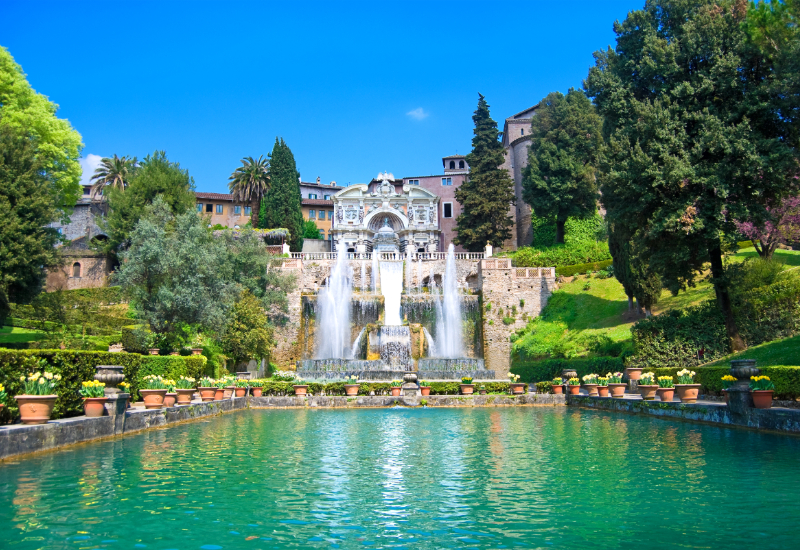
Exploring the history of the Cardinal’s palace in Tivoli reveals its true purpose. Every beautiful fountain and shaded grotto was made to tell a story. It shows power, art, and nature under his control. The Cardinal’s legacy is not one of a Pope, but of a man who built a world to prove he deserved to be one.
How Does a 500-Year-Old Fountain Play Music Using Only Water?
Among the hundreds of stunning water features at Villa d’Este, one is so audacious it has to be seen—and heard—to be believed. This is the Fountain of the Organ, a magnificent structure that, for nearly 500 years, has been capable of playing music. It’s not a recording or a modern trick. It’s a real musical instrument that runs on water. This amazing Renaissance creation will leave visitors in awe.
The genius behind this marvel lies in its clever use of natural forces. Water flows down through hidden channels. It traps air and pushes it into a chamber. This compresses the air like a bellows. When enough pressure builds, this trapped air is released through a set of organ pipes, producing clear, musical notes. Imagine a giant flute powered by water. This invention was so advanced for its time that it felt like magic.
To experience this Renaissance spectacle, however, timing is everything. The old, delicate mechanism works for just a few minutes. It plays a short piece of music for the waiting crowds. The performance happens on a set schedule.
It usually runs every two hours, starting in the mid-morning. For example, shows are at 10:30 AM and 12:30 PM. This makes it an event you really shouldn’t miss. Be sure to check the daily schedule upon your arrival and find a good spot.

While the Organ Fountain provides a scheduled performance, the rest of the garden offers its own constant, immersive symphony. It’s a world where water is not just seen but heard everywhere you go, creating a soundscape that is both thrilling and deeply calming.
Walk a Living Water Corridor: The Magic of the Hundred Fountains
After the Organ Fountain performance, you can enjoy music in the garden. You can walk along the Viale delle Cento Fontane, also known as the Avenue of the Hundred Fountains. This isn’t just a path; it’s a living waterway. Water shoots out from a line of masks and gargoyles for over 300 feet. This creates a mesmerizing tunnel of sound and cool mist. It’s one of the most enchanting walks in any garden in the world.
But this breathtaking feature is more than just decoration; it’s a direct tribute to the landscape surrounding Tivoli. The water flowing from the spouts represents three local rivers. These rivers are the Aniene, Ercolano, and Albuneo. They gave life to the region. You are walking next to a symbolic version of the garden’s water source. This is a clever nod to nature’s power in the man-made display.
This watery avenue acts as the garden’s main artery, connecting grand fountains at either end. It’s designed to overwhelm your senses with detail while guiding you deeper into the story. Follow it, and you will find the garden’s boldest part.
Why Is There a Miniature Rome Tucked Inside the Tivoli Gardens?
At the end of the long walkway, you arrive at the Rometta, or “Little Rome.” This is not just a fountain. It is a small model of ancient Rome. It shows tiny versions of famous landmarks. The water from the Hundred Fountains represents the local rivers. It flows into this scene, seeming to nourish the small city.
 But this miniature metropolis isn’t just a charming novelty. It’s a bold and clever political statement. Remember, Cardinal d’Este built this garden after failing to become Pope in Rome. By showing the waters in Tivoli flowing to support a small Rome, he sent a clear message. The great city relies on the resources from the surrounding area. It was his way of claiming superiority over his rivals from the comfort of his own backyard.
To understand the full story, you have to find the story’s beginning. At the opposite end of the garden sits the massive Fontana dell’Ovato, or Oval Fountain. This grotto-like structure has a dramatic waterfall. It was designed to represent the Tiburtine Mountains. These mountains are the natural source of the water that powers the whole garden.
In just a few hundred feet, the Cardinal tells a full story in water. It starts in the mountains of Tivoli at the Oval Fountain. Then, it flows through the land at the Hundred Fountains. Finally, it arrives to bring life to Rome at the Rometta. The whole garden tells a story, but it raises an interesting question: how did they make all this water move so powerfully?
The Secret to the Fountains: Unveiling the 16th-Century Hydraulic Genius
So, how did they power this spectacular water-world without a single electric pump? The answer is as simple as it is brilliant: gravity. The whole garden is a work of hydraulic engineering. This system was very advanced for its time. It still works perfectly today, over 500 years after it was built. It relies on nothing more than the natural slope of the land and the clever manipulation of water pressure.
The genius behind this feat was the architect Pirro Ligorio. He came up with a bold plan to take water straight from the Aniene River. This river is much higher than the garden. To do this, workers dug a huge underground channel that was almost half a mile long. This created a strong, high-pressure water source. It would supply every fountain, cascade, and grotto on the estate. It was an enormous infrastructure project for the 1500s.
This amazing technical achievement is a main reason why the Villa d’Este is a UNESCO World Heritage Site. The garden isn’t just celebrated for its beauty, but also as a landmark of human ingenuity. Ligorio didn’t just design a garden; he made a living machine. In this space, art and science work together in harmony. His design would influence gardens across Europe for centuries.
Seeing this 500-year-old system in action is a unique experience. It transforms the garden from a lovely relic into a living testament to Renaissance ambition. Thankfully, getting to Tivoli to witness this marvel firsthand is far easier than diverting a river.
Your Hassle-Free Day Trip: Getting to Tivoli and Buying Tickets Online
Making this fantastic Tivoli Gardens day trip from Rome is refreshingly straightforward. While there are a few options, each caters to a different travel style, ensuring you can get there with ease.
- By Train: The most common and scenic route for independent travelers.
- By Bus (COTRAL): A slightly longer but very budget-friendly alternative departing from Ponte Mammolo metro station.
- By Organized Tour: The most effortless option, with transport and tickets often handled for you.
If you want to take a train from Rome to Tivoli, here’s an important detail. Direct regional trains leave from Rome’s Tiburtina station.
They do not leave from the main Termini station. Don’t worry—Tiburtina is a major hub easily reached on Rome’s Metro (Blue Line B). The journey takes about an hour, offering pleasant views of the Roman countryside as you leave the city behind.
Before you even leave Rome, do yourself a huge favor by buying Tivoli Garden tickets online. The ticket line at the Villa d’Este, especially during peak season, can be long and slow-moving. Buying your ticket early from the official website or a trusted seller helps you avoid the main line. This saves you time, which you can use to explore the gardens.
Once you arrive at the station in Tivoli, you’re just a pleasant 10- to 15-minute walk from the Villa d’Este’s entrance. The path winds up through the charming medieval streets of the town itself, building anticipation for the wonders that await. With your travel sorted and tickets in hand, you’re ready to make the most of your visit.
How to Plan the Perfect Day in Tivoli (And Should You Visit Hadrian’s Villa?)
Once you arrive, the biggest question is how to pace yourself. So, how long do you need for the Tivoli fountains? To truly soak in the atmosphere of Villa d’Este without feeling rushed, plan for at least two to three hours. This gives you plenty of time to walk along the shaded paths. You can find hidden grottoes and sit quietly. Listen to the soothing sounds of water, which is the main purpose of the experience.
Before finalizing your schedule, you should know about Tivoli’s other world-famous site: Hadrian’s Villa (Villa Adriana). It’s crucial to understand the difference between Villa Adriana vs Este gardens. Villa d’Este is a beautiful 16th-century Renaissance garden.
In contrast, Hadrian’s Villa is a large area of ancient Roman ruins from the 2nd century. Think of Villa d’Este as a well-preserved work of art and engineering. Hadrian’s Villa feels like exploring the ruins of an emperor’s private city.
For an ambitious but incredibly rewarding one-day in Tivoli itinerary, consider tackling both. Start your morning at the more exposed and expansive Hadrian’s Villa.
After that, go to Tivoli’s lovely town center for a nice lunch. Then, spend your afternoon in the cool, misty gardens of Villa d’Este. This sequence works beautifully with the sun and your energy levels.
Ultimately, the choice depends on your interests and time. If you’re a true history enthusiast, seeing both Hadrian’s Villa and the Gardens of Tivoli is a must. If you want a more relaxed day trip, focus on the beauty and art of Villa d’Este.
This is a great plan. It’s a place meant to be seen and felt. It represents a dream powered by water that has amazed visitors for centuries.
More Than a Garden: The Lasting Legacy of a Water-Fueled Dream
You used to see a beautiful Italian garden. Now, you can see the work of a defeated cardinal who created his own paradise. You can see the smart design of its engineering. It is a mix of water and gravity. This blend of art, ambition, and nature is what makes it a UNESCO World Heritage site. This isn’t just a place anymore; it’s a story you can now read in every jet of water and shaded grotto.
This new lens transforms a potential visit from a simple walk into an exploration. You can appreciate Italian Renaissance garden design.
If you’re planning a fun day in Tivoli with kids, you can also see the effort that went into creating the beauty. Begin by listening for the ‘voice’ of the Oval Fountain. You will see how quickly the garden’s story comes to life around you.
Villa d’Este is not just a historical site. It shows that from deep personal disappointment, great beauty can emerge. It is a dream of water and stone that, five centuries later, still feels utterly and breathtakingly alive.