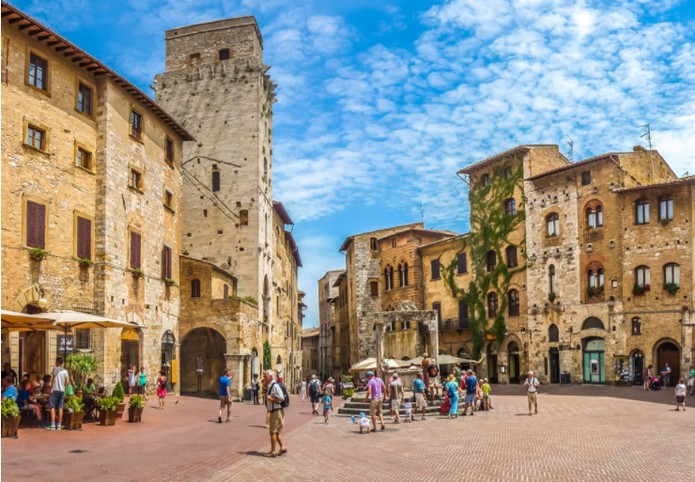
Imagine a skyline not of glass and steel, but of ancient stone towers rising above the Tuscan hills. This is San Gimignano, a town preserved in time for 700 years.
But why did one small town build so many medieval towers? The answer is a fascinating story of rivalry, power, and pride.
Explore San Gimignano: Tuscany’s Medieval Gem
In most cities, history is a hidden layer; here, it’s the main event.
Walking the narrow cobblestone streets of the Historical Centre of San Gimignano feels like entering the 14th century. Back then, powerful families fought for prestige not with money, but with stone and mortar.
This incredible preservation wasn’t planned. A sudden economic downturn froze the town in time, halting new construction and cementing its medieval character.
This perfect moment led UNESCO to declare it a World Heritage site in 1990. This ensures its unique skyline will be protected for future generations.
The Ultimate Medieval Status Symbol: How Family Feuds Built a Skyline
While the towers could serve as fortified retreats, their primary purpose was pride, not protection. They were the skyscrapers of the Middle Ages.
Building the tallest tower was a major status symbol. It was the best way for a wealthy family to show their power in the Tuscan countryside.
This fierce competition created an astonishing skyline. At its height, San Gimignano had 72 towers. This made the small hilltop town look like a stone forest. Each new tower was a direct challenge to a rival—a constant, vertical battle for dominance.
The rivalry was so intense that the city council banned any tower from being taller than the town hall. Powerful families quickly tried to get around this rule.

Fueling this architectural arms race was a deep-seated political conflict. The town’s noble families were divided into two groups. The Guelphs supported the Pope, while the Ghibellines backed the Holy Roman Emperor. These family towers became the physical symbols of this bitter feud. But building this high required a powerful economic engine.
How Pilgrims and a Precious Spice Funded the Tower Race
This enormous wealth flowed from two key sources. The town is located on the Via Francigena. This was a major pilgrimage route to Rome. It was like the M1 motorway in the Middle Ages. This constant stream of travelers, merchants, and pilgrims turned the town into a bustling, profitable hub for medieval Europe.
Even more important was a delicate flower: saffron, the “red gold” of its time.
- This spice comes from crocus flowers.
- It is hand-harvested.
- It was important for dyeing fabrics.
- It was also used in medicine and cooking.
The immense profits from the saffron trade made the town’s leading families fantastically wealthy.
With money pouring in from pilgrims and the spice trade, San Gimignano’s elite had the cash to fund their ambitions. Every florin earned was another potential stone laid, another step higher than their rivals. This economic boom, however, was not destined to last.

Frozen in Time: The Surprising Reason San Gimignano Never Changed
San Gimignano’s golden age ended abruptly in the mid-14th century. The Black Death decimated its population and crippled its economy. Weakened, the town surrendered its independence to its powerful rival, Florence, in 1354. With its wealth and power gone, the competition to build ever-higher towers stopped.
Progress froze. The town did not have enough money to tear down old buildings and build new ones. This is what happened in Florence and Siena. As a result, the town simply stopped changing. This sudden poverty strangely helped keep its medieval character. As a result, the skyline of this unique hill town stayed almost unchanged for the next 600 years.
This unplanned deep freeze makes San Gimignano’s history special. While other cities changed during the Renaissance, it stayed a true medieval time capsule. This offers a rare look into a lost world and is a key reason for its UNESCO status.
What Makes San Gimignano a ‘Masterpiece’ in UNESCO’s Eyes?
Its perfectly preserved state is exactly why UNESCO granted San Gimignano World Heritage status. This title recognizes the town’s “outstanding universal value.” UNESCO’s committee highlighted three main reasons:
- A Masterpiece of Human Genius: It has an unforgettable skyline of medieval towers. This unique creation has inspired artists for centuries.
- A Window into a Past Civilization: offering a rare, authentic look at life in a powerful Italian city-state during the Middle Ages.
- A Great Example of Architecture: This shows a time when competing families built tall houses. They did this to display their wealth and power.
San Gimignano is a living historical document. Its striking look, medieval layout, and the stories its towers tell make it an important part of human history.
Your One-Day Itinerary: How to Walk Through 700 Years of History
Exploring the old town of San Gimignano feels like being on a movie set.
A simple walking route is the best way to enjoy it all. Your journey starts in the town’s connected hearts. First, visit the triangular Piazza della Cisterna. This square is built around a well from the 13th century. Next, explore the nearby Piazza del Duomo. This area is the historic center of civic and religious power.
From the Piazza del Duomo, look for the town’s tallest structure.
To grasp the town’s scale, climbing Torre Grossa is a must. It’s the only one of the original 72 towers fully open to the public. The 218-step climb is a good workout. The reward is a stunning view of the Tuscan countryside and the tall stone mountains.
Back on the ground, step inside the unassuming facade of the Collegiata church.
See the frescoes as they were meant to be seen. They are large, wall-to-wall storybooks. They show bright scenes from the Old and New Testaments. These artworks were made to teach people who could not read. This one-day itinerary lets you see, feel, and climb through centuries of history. But to complete the experience, you also have to taste it.
Beyond the Towers: Tasting History with Vernaccia di San Gimignano
While the towers reach for the sky, San Gimignano’s other claim to fame comes from the earth. The town is home to Vernaccia, a crisp white wine with a history as rich as the town itself. Praised by Dante in the 14th century, it is a true taste of the Middle Ages.
The wine’s importance isn’t just a matter of ancient history. In 1966, Vernaccia di San Gimignano was the first wine in Italy to get the DOC designation. This official seal shows its true origin and respect for old traditions.
For visitors to Tuscany’s hill towns, tasting the local wine offers a direct connection to the land. Ordering a glass of Vernaccia in a sunny piazza is a great way to end a day of exploring. You can enjoy a taste of history made here for over 700 years.
San Gimignano Logistics: Getting There, Parking, and Planning Your Day Trip
Ready to plan your visit? The best way to get to San Gimignano from Florence via public transport is a two-step journey. First, take a regional train to the Poggibonsi-San Gimignano station. From there, a regular bus service (line 130) makes the final 20-minute trip up the hill to the town’s main gate.
For those arriving by car, the most important rule is the ZTL (Zona a Traffico Limitato). This is a “no-drive zone” for visitors, protecting the ancient city center.
You cannot drive inside the town walls. Please follow the signs to the paid parking lots (P1, P2, etc.). They are just a short walk from the entrance.
Many travelers debate whether to choose San Gimignano or Siena for a day trip. Pick San Gimignano for a focused, perfectly preserved medieval experience that feels like a time capsule. For a larger, livelier city with more to see, Siena is your best bet.
Now, when you see those fourteen towers, you see their story.
It is about a fierce rivalry in medieval times. Powerful families aimed high, and their ambition was shown in stone. This is why San Gimignano is more than a postcard; it’s a journey into a preserved moment of history.
As you walk its streets, you see a town that feels frozen in time. You read a living story. You understand why this unique human tale is a treasure worth protecting for everyone.